Mar
11
2010
0

Secrets of Body Language Review

Secrets of Body Language” is a 100 minute video production by the History Channel. In this DVD, body language experts observe politicians and celebrities to analyse their non-verbal gestures. It also demonstrates how subtle gestures is used to persuade the masses and establish power.

The video below is a snippet of the production. The experts are analysing the gestures and tone inflection of Obama, McCain and Hillary.

As watched from the above video, the video enables viewers to see body language in action, and the experts clearly explain their points of analysis. If you are reading any body language book, “Secrets of Body Language” will no doubt reconcile your book knowledge with the real world.

History Channel Presents - Secrets Of Body Language NEW
US $9.99
End Date: Saturday Mar-27-2010 14:25:10 PDT
Buy It Now for only: US $9.99
Buy it now | Add to watch list
Click for more details

Buy this illuminating video on body language in action from Amazon.com. Or click the “Click For Details” button to buy it from Ebay.

  • Share/Bookmark
Written by logish in: Recommended Body Language Resources |
Mar
08
2010
0

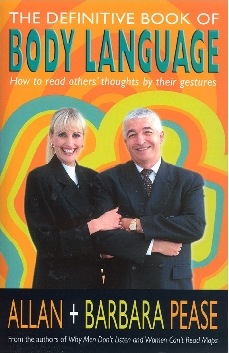
The Definitive Book Of Body Language Review

The Definitive Book Of Body Language : How to read others’ thoughts by their gestures is an excellent book that explains body language in the context of business and networking. The illustrations and visual-aids help novices understand how to read body gestures in a real situation.

defbodl

The manner in which this book is written is entertaining, and the authors occasionally drop in body language facts about the opposite sex. Because of the comprehensive knowledge contained in the book, the authors have created a chapter to advise their readers on interpreting body language.

This is no doubt a must-have if you want to have an understanding of body language and be able to communicate better. Buy it now from Pease International (the company of the authors, Allan and Babara Pease).

  • Share/Bookmark
Written by logish in: Recommended Body Language Resources |
Mar
04
2010
0

Spot That Liar!

Learn some tips from a ex-FBI officer to detect liars. I would caution you to look at the gestures as a whole, so that it confirms interpretation.

Logen L.

  • Share/Bookmark
Jun
13
2009
0

Make Use Of Your Face

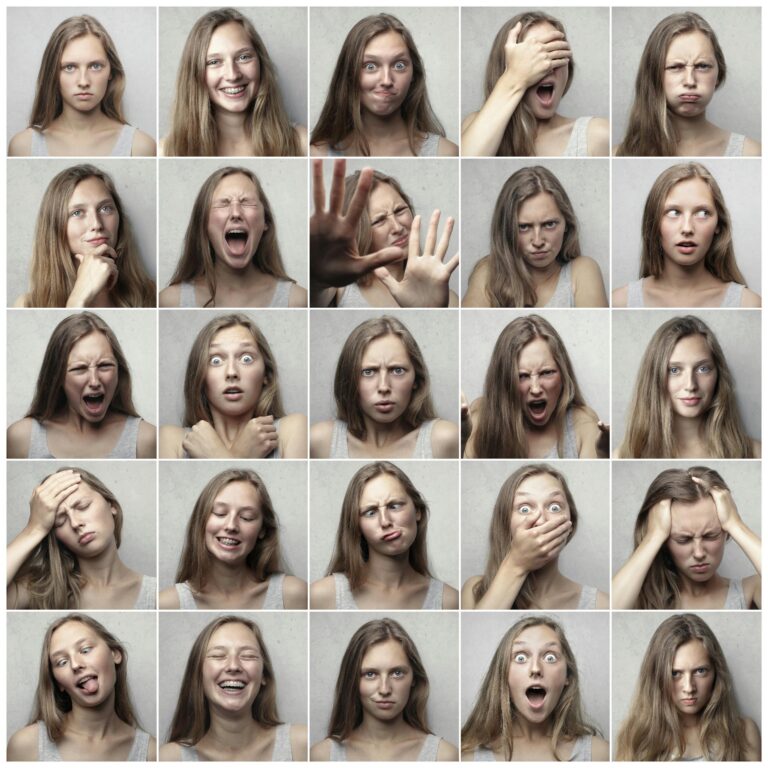
It’s no secret that the hands and the face, the most expressive parts of the body, have a language all their own that accompanies speech and other human interaction. For example, light touching of the face often indicates nervousness, and lightly covering the mouth while speaking is linked with deception.

Good stage actors have a ready repertoire of hand-to-face gestures for conveying a character’s state of mind. The hand-to-mouth gesture with a closed fist indicates a character’s dishonesty, and is often punctuated by a fake cough, as if the cough, and not the lie, were the reason for putting a hand to the mouth.

The look of shock and fear is often amplified by lightly touching the sides of the face with the fingertips, while at the same time widening the eyes. Sorrow or sadness can be effectively conveyed with fingers lightly spread and palms touching the face.

Most everyone is familiar with the “facepalm,” or putting the face in the open palm as a sign of having done something stupid. Rapidly waving one’s hands in front of the face, with palms facing the other person indicates belief that the other person is full of nonsense.

But perhaps people need more help in avoiding these revealing gestures than in doing them. Even people who aren’t interested in deceiving people may want to avoid looking nervous or incompetent when meeting someone or giving a speech.

There’s nothing wrong with writing directions into any notes you use when giving a speech. They might say “raise arms to indicate size of fish,” or “emphasize your surprise by touching sides of face, widening eyes.” It’s even better if you commit your entire speech and planned body language to memory by practising.

If you are speaking to people while sitting down, perhaps while giving testimony in a court matter, it is wise to avoid touching your face if you can do it without fidgeting too much. Politicians are often pictured or videotaped touching their faces while speaking, and we all know what most people’s opinion of politicians is!

Once you know your own gesturing habits and how they might be interpreted, you can more easily project the confidence you want when meeting others or speaking to a group

Joyce

edited by: Logen

  • Share/Bookmark
Written by logish in: Face Touch Gestures | Tags:
Jun
06
2009
0

What Does Touching The Face Say About You?

The hands and face are the most expressive parts of the body. When body language involves using the hands and the face at the same time, the effect is much more forceful than intonation or speech alone. If someone tells you something while scratching the side of the face and avoiding eye contact, you’ll probably wonder if he’s telling the truth. But if a person returns eye contact, and his arms are relaxed, you’ll probably trust what he is saying.

[ The best way to remember what hand-to-face gestures indicate is to remember: "See no evil, hear no evil and speak no evil.". ]

Gestures involving the hands and the face are widely believed to be accurate indicators of truthfulness. Scratching non-existent itches along the jawline, or excessive playing with one’s own hair raise suspicion. What some people call the “see no evil” gesture, or gently rubbing under one eye with a finger, is associated with lying. A person touching their face, eyes flitting from object to object avoiding eye contact is also often interpreted as lying.

The “speak no evil” gesture of putting a finger across the mouth, or covering the mouth before or after speaking can be a subconscious way of stopping a lie from coming out of the mouth. Actors trying to portray deception will sometimes use a similar gesture. Touching the nose is also believed to be a clue to deception.

Everyone has heard the phrase “hot under the collar,” and it has its origins in hiding lies. Flushing of the neck, or warming of the neck without flushing, causing a person to run a finger around the inside of his or her collar (in an attempt to dissipate the heat) is believed to be a very accurate sign of dishonesty.

While many of these gestures accompany boredom as well, one way to tell the two apart is whether or not the person is actually supporting his or her head with a hand, or if the hand is merely touching, and not supporting the head. Lighter facial touching is more likely to be a sign of nervousness, especially when accompanied by other clues, such as shuffling of the feet.

Joyce

edited by Logen

photo: http://www.flickr.com/photos/amanky/1456106068/sizes/m/

  • Share/Bookmark
Written by logish in: Face Touch Gestures |
May
30
2009
0

Use Your Arms To Emphasise Your Words

Researchers debate whether hand and arm gestures add to the meaning of verbal speech. In other words, do the hand and arm motions people make get the meaning of their speech across better than a lack of hand and arm motions? There are arguments both ways: that gestures are integral to understanding a speaker’s real meaning, and that they are not, as evidenced by the popularity radio broadcasts, podcasts, and various other audio media.

[ Whether you realise it or not, many people communicate with their hands ]

Perhaps the question should be, how do hand and arm gestures reinforce or contradict what is being said through speech? There is little question that a person’s hand and arm gestures can reveal deception, frustration, or truthfulness.

Certain arm gestures convey seriousness, as evidenced by the mother crossing her arms firmly upon catching her child doing something he shouldn’t do. Broad arm gestures indicate enthusiasm, though if they’re overdone, they can indicate a lack of confidence.

If you are meeting someone for the first time, or if you are giving a talk to a room full of people, the actions of your hands and arms will tell their own story. Whether it matches or contradicts what you want to communicate is something you can learn to control to some extent.

Generally speaking, the more relaxed arms and hands are, the freer they are to move, the more confidence you project. Arms stiffly held by the sides with fists clenched indicate anger or fear. Stiff or crossed arms with small, agitated motions of the hands signal dishonesty, as do hands clasped behind the back when one is looking at the ground.

On the other hand, overly broad hand and arm gestures can make a person look as if he is trying too hard, again raising the question of the speaker’s honesty. When someone’s arms are roughly at their sides, elbows slightly bent, and hands relaxed, they appear confident and truthful. If you practice this stance in speaking or situations in which you are introduced to others, you will learn to consistently convey a sense of trustworthiness and competence.

Joyce

edited by Logen

photo: http://www.flickr.com/photos/patssnaps/2119380970/sizes/m/

  • Share/Bookmark
May
23
2009
0

What Can The Arms Reveal?

Arm and hand gestures are every bit as revealing as speech and facial expressions. Generally, the more relaxed hands and arms are, and the less exaggerated the motions of the hands and arms, the more open, truthful, and comfortable the person is.

When a person holds their arms still, whether crossed, or by their side, they are indicating discomfort. This could be due to being in the presence of someone of higher status – like a student with a school principal – or it could be due to nervousness, hostility, or dislike.

Arms held still with minimum, or exaggeratedly small gestures indicate that a person may be lying. A liar may even hold one arm with the other in order to keep both arms still. This person looks like they are trying to minimize the space they take up.

People wave their arms like windmills when they are excited and confident, but when they lack confidence, people make smaller arm and hand gestures. A person quickly raising both arms in the air is trying to tell you that they are frustrated. You see this gesture in business and social situations.

The most recognizable hand-arm signal is arms firmly crossed in front of the body. Crossed arms can signal many things, but they almost always signal a degree of discomfort, whether in a social or business situation.

Meanings attributed to crossed arms include: defensiveness; anxiety; distrust; vulnerability; and even suppression of rage. The rigidness of the crossed arms indicates the degree to which a person is closed off. Arms folded with hands made into fists indicate real hostility, particularly when accompanied by crossed legs.

A hand-arm gesture that indicates confidence and self-assurance is that of hands loosely clasped behind the back, head held high. This is a posture used by teachers evaluating students’ work and policemen patrolling on foot. The fact that the front of the body is left unshielded signals a sense of authority and self-esteem.

Arm and hand gestures are a language unto themselves. You can watch very old silent movies and see how important the movements of the hands and arms are. Even without hearing speech, you can often get an accurate idea of exactly what is being communicated when arms and hands do the talking.

Joyce

photo: http://www.flickr.com/photos/artmakesmesmile/169193698/sizes/m/

  • Share/Bookmark
Written by logish in: Hand and Arm Gestures |

Powered by WordPress. Theme: TheBuckmaker. Vergleich Kredit, Nagerkaefig